
The Short Answer
If your garage door is from the 1990s or earlier, you don't need to replace the whole thing. You need to retrofit the safety hardware — the parts that failed inspections and recalls over the past 30 years for good reason — and leave the rest alone as long as it's working smoothly. One spouse is usually right that 'it still works fine.' The other is usually right that 'something on there is outdated.' Both can be true at once.
What to Retrofit Now
These are the items worth fixing even on an otherwise healthy old door, because they're the difference between a door that misbehaves and a door that hurts someone.
- Photo-eye sensors: If your opener doesn't have the two small sensors mounted a few inches off the floor on either side of the track, it predates federal auto-reverse requirements from the mid-1990s. A door that can't sense a kid's bike or a pet in its path needs this opener upgraded or replaced, full stop.
- Torsion spring safety cables: If you have exposed torsion springs above the door with no cable running through the center, a spring failure can send metal flying. Cables are a cheap retrofit that contain the spring if it snaps — there's no good reason to skip this.
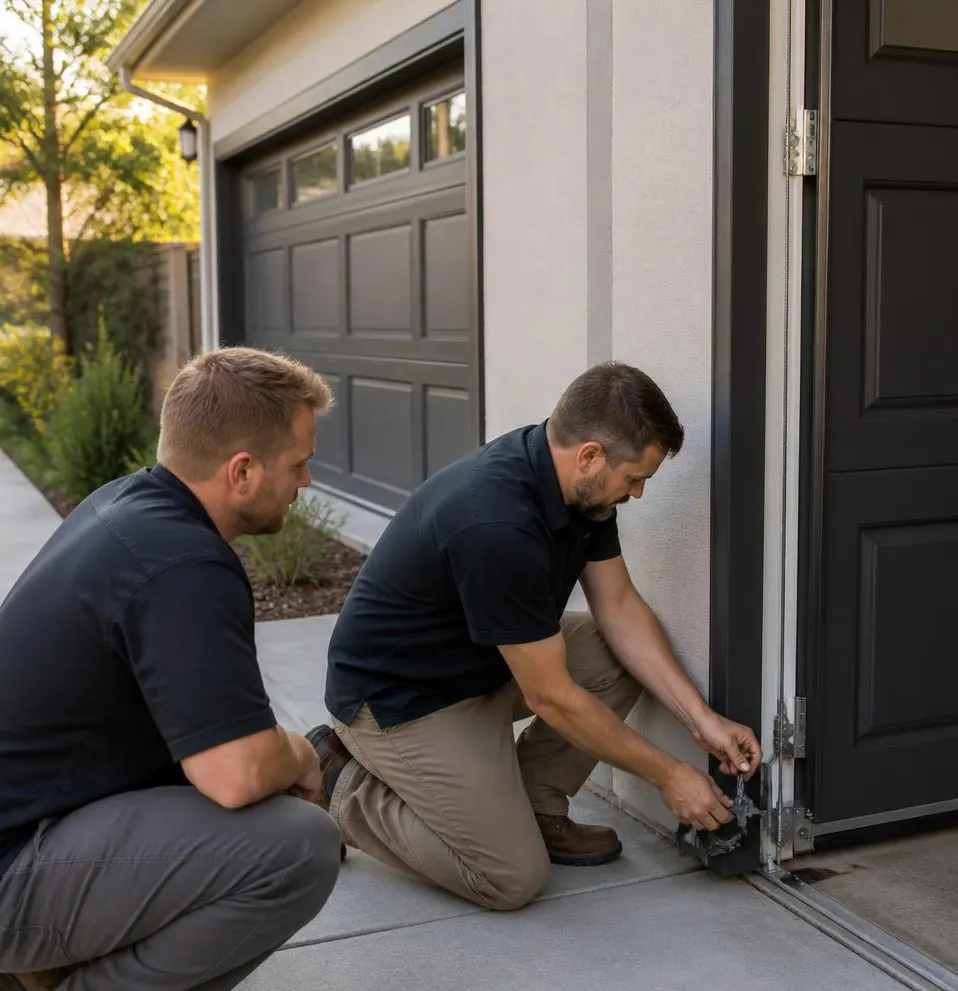
- Bottom bracket shields: Older doors sometimes have exposed cable brackets at the bottom corners that can pinch fingers. Covered brackets are a low-cost swap during any other service visit.
- The opener itself, if it still has a chain-style wall button with no auto-reverse test: Press and hold the wall button to close the door, then set a 2x4 flat on the ground where the door will land. If the door doesn't reverse on contact, that opener is a liability, not a convenience.
- Manual release awareness: If nobody in the house knows where the red emergency release cord is or how to use it during a power outage, that's a five-minute conversation, not a repair — but it matters just as much.
What's Fine to Leave Alone
This is usually where the argument actually lives, so here's the honest version.
- Original wood or steel panels that aren't warped, delaminating, or rusted through: Cosmetic wear from 30 Ohio winters is not a safety issue. If the door still seals, still tracks straight, and isn't dragging, there's no functional reason to replace panels just because they're old.
- Torsion springs that are properly sized and still cycling smoothly: Springs wear out from cycle count, not calendar age. A spring that's quiet, balanced, and holding the door at half-open without drifting doesn't need to be replaced on a schedule — it needs to be replaced when it shows wear (gaps between coils, rust pitting, or a door that suddenly feels heavier).
- Chain-drive openers, as a drive type: Chain drives are louder than belt drives but not less safe. If the motor itself is healthy and the safety reversal works, swapping to belt drive is a comfort upgrade, not a necessity.
- Original tracks and rollers, if they're not bent or cracked: Steel rollers squeal more than nylon ones, but squealing is a lubrication problem, not a replacement problem.
Why This Matters More Here
Fairfield County's winters put more stress on an old door than most people realize. Ice buildup at the bottom seal, road salt tracked in on tires and boots, and big temperature swings between a 60-degree afternoon and a 15-degree night all work against aging hardware. Metal contracts, grease stiffens, and a spring or cable that's already marginal is more likely to fail on the first hard-freeze morning than on a mild July day. That's exactly why the safety retrofits above are worth doing before winter sets in rather than after a problem shows up. Come spring storm season, the same logic applies in reverse — a door that auto-reverses reliably and seals well is one less thing to worry about when wind and debris pick up.
How to Settle the Argument
Walk out to the garage together and check three things: does the opener auto-reverse when it hits something, are the torsion springs covered with a cable, and is the bottom seal still sealing out drafts and water. If all three check out, the door itself can stay exactly as it is. If any one of them fails, that's the retrofit to schedule — not a full replacement, just the specific fix.
When to Call Lancaster Garage Door
If you're not sure whether your springs are original, whether your opener has working auto-reverse, or whether that squeal is normal wear or a bent track, that's worth a second set of eyes before winter weather makes small problems bigger. Lancaster Garage Door handles spring replacement and garage door opener service for homes across Lancaster, Carroll, Pickerington, and the rest of Fairfield County, and can tell you in one visit what's a genuine safety retrofit versus what's cosmetic and fine to leave alone.
If you're searching for a straightforward garage door company in Lancaster, OH to check an older door before the cold weather hits, give Lancaster Garage Door a call — we'll tell you the truth about what needs fixing and what doesn't.